Nevada has no single statute we could find that requires carbon monoxide alarms in every home, but Northern Nevada's fire code amendments require CO detection in buildings with certain fuel-burning or garage conditions. If your house has a gas furnace, a fireplace or an attached garage, plan on having CO detection.
Key points
- We found no single Nevada law requiring CO alarms in all homes.
- Northern Nevada fire code amendment 915.1.1 lists the conditions that call for CO detection.
- An attached garage or forced-air furnace on that list is common in local homes.
- Detection can be stand-alone alarms or part of a monitored system.
- Follow the manufacturer's instructions for placement and replacement.
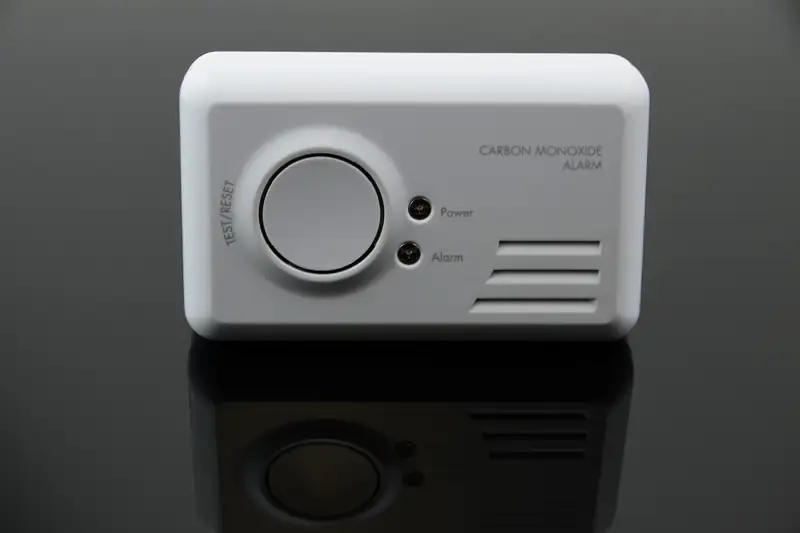
Carbon monoxide has no smell and no color, which is why a working detector matters more than your senses. The rules that decide whether you need one in Nevada are a patchwork, and most of the real requirement comes from the local fire code rather than state law. Here is how it fits together.
What the statutes say
The National Conference of State Legislatures keeps a table of carbon monoxide detector statutes by state, updated September 29, 2025. For Nevada it lists only one entry, NRS 244.35356, which lets counties set requirements for transient lodging such as short-term rentals. We found no statute in Nevada requiring CO alarms in every home.
That does not mean you are off the hook. Fire codes adopted locally carry requirements of their own, and those are the ones inspectors apply.
What Northern Nevada's fire code requires
The regional amendment set to the 2024 International Fire Code, which Reno enforces and which the Truckee Meadows Fire Protection District follows with Washoe County amendments, adds section 915.1.1. It requires carbon monoxide detection in a building that has any of the following:
- a carbon monoxide source of its own;
- a fuel-burning forced-air furnace that can produce carbon monoxide;
- an attached private garage;
- a vehicle that produces carbon monoxide and is used inside the building;
- a Group R-3 residence used for transient stays of under 30 days, such as a short-term rental.
Many homes in this area meet at least one condition, since gas furnaces and attached garages are common. The amendment applies as the code applies to permitted work, so ask your local building or fire office how it applies to your house.
Where detectors go
Where the code applies, it specifies the locations (IFC 915.2), and the manufacturer's instructions cover the mounting details. In general, plan on detection near sleeping areas and on each level of the home, and consider the area near an attached garage or fuel-burning appliance.
Do not mount a CO alarm right next to a fuel-burning appliance where it might trigger on normal start-up, and do not cover it with paint or let dust build up on it. Read the maker's guide for the exact rules.
Stand-alone alarms or a monitored system
A stand-alone alarm sounds in the house. That works when someone is home and awake. A monitored detector, tied into a system that reports to a central station, also sends a signal when nobody is there, which matters for second homes and for homes you leave for the day.
Systems of Nevada installs monitored smoke and carbon monoxide detection for homes. See our page on monitored smoke and CO detectors and the guide to how monitored smoke detectors work. Our work in this area is low-voltage detection and alarm systems.
Short-term rentals and landlords
The one line in the NCSL table that mentions Nevada concerns transient lodging, and the local amendment also names residences used for stays under 30 days. If you rent out a house, cabin or condo in Reno, Incline Village or elsewhere in the region, check your local rules and keep records of when detectors were installed and tested. Our page for property managers and rentals covers systems for those properties.
When an alarm goes off
- Get everyone out into fresh air and call 911 from outside.
- Do not go back in until the fire department says the home is clear.
- Have the source found and fixed by a qualified professional before using the appliance again.
- Check that the alarm has recovered and replace it if the manufacturer says it should be.
Sources (3)
- ncsl.org: ncsl.org/environment-and-natural-resources/carbon-monoxide-detector-installation-statutes (checked November 2026)
- City of Reno: reno.gov/Documents/Fire/Prevention/2024%20IFC%20amendments%20RFD%20012026.pdf (checked November 2026)
- Truckee Meadows Fire Protection District: tmfpd.us/fire-code/ (checked November 2026)