
Cat6A carries 10 gigabit Ethernet the full 100 meters, while Cat6 is rated for 10 gigabit only over a shorter run, about 37 to 55 meters depending on conditions. For most home runs Cat6 is plenty today, and Cat6A is the safer choice when you are wiring a new building, a large site or a backbone you will not want to redo.
Key points
- A cabling channel is limited to 100 meters: 90 meter permanent link plus patch cords.
- Cat6A supports 10 gigabit over the full 100 meters; Cat6 is rated for about 37 to 55 meters at 10 gigabit.
- Cat6A is thicker and stiffer, which affects pulling and bending.
- Run it where the walls are open; changing it later is harder.
- We do low-voltage cabling under license 0042143.
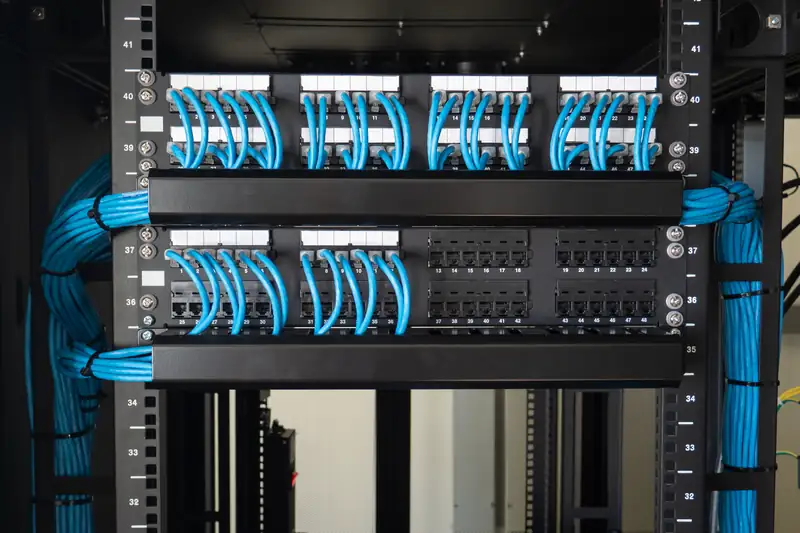
Cabling is one of the least costly things to do right and one of the most expensive to redo. The decision between Cat6 and Cat6A is usually about the next ten or twenty years, not this year.
The numbers
The figures here come from the TIA-568 cabling standard family as summarized by CommScope and the Category 6 cable reference. Published figures for Cat6 at 10 gigabit run from about 37 to 55 meters depending on conditions, and the standard itself is sold by its publisher.
| Cat6 | Cat6A | |
|---|---|---|
| Channel length | 100 meters maximum | 100 meters maximum |
| 10 gigabit Ethernet | About 37 to 55 meters | Full 100 meters |
| Cable thickness | Thinner, easier to pull | Thicker and stiffer |
| Common use | Homes and offices today | New builds, longer runs, backbone |
A channel is the whole path: 90 meters of permanent cable in the wall plus patch cords at each end.
What that means in a house
Many home runs are short, so Cat6 can handle 10 gigabit on a typical run in principle. Equipment today often runs at 1 gigabit and sometimes 2.5 or 5 gigabit, which both categories handle easily.
Where Cat6A earns its place is a long run, a large house, a backbone between buildings or a spot where the cable will stay in the wall for decades. It is also a sensible pick when the equipment later moves to 10 gigabit.
The handling difference
Cat6A cable is thicker, so it takes more room in conduits, boxes and bends. It is not difficult for a trained installer, though it needs care and the right jacks and panels. Cat6 is easier to route in tight spaces.
That is a reason to settle the question before walls are closed. See the prewire checklist and our network and data cabling page.
A way to decide
- Measure or estimate the longest run from the hub to a room.
- Ask whether anything in the house will need 10 gigabit soon, such as a server, workstation or video editing.
- Check the space in the wall, conduit and wiring hub.
- Decide whether this is a cable you will redo or leave for decades.
- Ask us to price both options for your plan.
Cost and future planning
Cat6A cable and its jacks and panels cost more than Cat6, and it costs more to pull because of the thickness. The cost of the cable itself is usually small next to the labor of running it, and the labor is the same whichever you choose. That is why the decision about future speeds is worth making once, at the start, with the walls open.
We quote both options for your plan so you can see the difference in your own project instead of a rule of thumb. Remember that the equipment on each end sets the speed you actually get; the cable only sets how high it can go.
Cable is only part of a working network. Termination, labeling, testing and a tidy rack decide whether a good cable performs the way the standard intends, and that care is why we handle runs from rack to jack ourselves.
Where it fits in a project
The cable ends at a rack or panel in the hub, which is covered on our telecom rooms and racks page. If you are planning WiFi, the smart-home WiFi guide explains why each access point needs its own cable.
Nevada defines the C-2d Low Voltage class for systems up to 91 volts, including computer networking systems, per the administrative code. Our Nevada State Contractors Board license 0042143 includes it.
Sources (3)
- commscope.com: commscope.com/cat-6a/ (checked November 2026)
- Wikipedia: en.wikipedia.org/wiki/Category_6_cable (checked November 2026)
- law.cornell.edu: law.cornell.edu/regulations/nevada/NAC-624-200 (checked November 2026)